Maritime Compliance Data Platform

Turn vessel operations into auditable compliance data.

Morning reports, fuel delivery records and voyage boundaries connect with regulatory rules in one deterministic model — built for EU ETS Maritime, FuelEU Maritime and EU MRV reporting.

EU ETS Maritime, FuelEU Maritime and Mediterranean environmental requirements each operate on distinct scope and phase rules. Poseidon resolves the applicable regime before calculating the result — per leg, per vessel.

Surrender rate 100% for 2026 emissions · phase-in 40% (2024) · 70% (2025)
Surrender deadline 30 September 30 Sep 2026 · surrender for the 2025 reporting year · excess emissions €100 / t CO₂
Med SOx ECA 0.10% Sulphur cap in the Mediterranean · from 1 May 2025 · fuel documents retained
FuelEU deficit penalty €2,400 / t VLSFO-eq deficit basis · statutory penalty formula, FuelEU Art. 24

Compliance starts below deck — not in the platform.

The EU rules require verified consumption on EU-specific legs. Shipboard operations already hold that answer, but it lives scattered across systems people touch every day.

01
Morning reports stay unstructured
NOON / EOS report layouts, units and rounding differ by vessel — a silent per-report inconsistency before any calculation begins.
02
BDN and delivered reality drift apart
A Bunker Delivery Note shows what was invoiced. What was actually received, and burned, lives in tank soundings — and they do not always agree.
03
Voyage boundaries are ambiguous
EU / EU-out / Extra-EU phases carry different rules. Correct ETS accounting depends on leg definitions that crew logs rarely label.
04
Reporting is one platform, operations another
Verifier-facing MRV portals and shipboard ops systems each speak their own language — the reconciliation burden falls on you.
Day → Leg Compliance unit is the leg · operating unit is the day
Ledger
2026-03-04 · 12:00
NOON REPORT — ROB 88.4 t
src · EOS
Interval delta
41.8 t MGO consumed
rule · ROB DELTA
Posting target
Voyage #124 · Leg 2
chain · continuous
Phase factor
EU-out · 50%
rule · 2023/959

One morning report, one attribution. Same shape for 15,000 reports a year — each with its own chain of custody.

A deterministic path from raw fuel time series to compliance-grade output.

01 Onboard Source Data
NOON and end-of-day reports, BDN and ROB files, port calls and position logs are received in their original formats and preserved untouched. Poseidon Ledger reads the data as delivered.
02 Parse into a Raw Ledger
Formatting is detached from content. Layout variations, units and rounding are normalised into a single structured fuel-consumption ledger, while the original documents remain linked to every row.
03 Bound the Voyage
Port calls are timed from position and allowance records. Voyage evidence — routing records, bills of lading and position logs — determines the port pair and voyage phase for every leg.
04 Continuous Posting
Consumption is published to the leg as the data arrives. Postings accumulate per leg only while the ship is in that leg — attribution follows the operating profile, not a forecast.
05 Resolve Gaps
Wide weekend reports, switchboard gaps and missing ROB readings are resolved from the remaining evidence in a stated order — and every exception is surfaced with its own chain of custody.
06 Deterministic Calculation
Leg-level consumption, distance by voyage phase and emission factors are resolved against the regulatory rules into emission quantities and FuelEU intensity. Same inputs, same output, always.
07 Audit-Ready Record
Each reported figure references its source records and the exact rule applied. Any number in any report can be traced back to the raw data that produced it — in one click.
Attribution ladder — how assembled fuel consumption is prioritised
Level 1 · Highest
NOON INTERVAL
Two ROB readings flank the day — direct observation from the bunker ledger, no estimation.
Level 2
ROB DELTA
Missing one reading — consumption inferred from a prior ROB plus delivered fuel (BDN / duplicate-delivery file).
Level 3
BDN-TO-VOYAGE
No portable diagnostics — a BDN spanning the interval is reconciled to the voyage plan and machinery limits, with assumptions stated.
Level 4 · Lowest
INSUFFICIENT DATA
No usable evidence — the interval is surfaced, never estimated. An exception that must be resolved on board or in the office.

The rules Poseidon Ledger calculates.

Our scope is deliberate: the emission regulations that turned vessel operations into formal, verifiable paperwork. Nothing more, and nothing less.

01
EU ETS Maritime
CO₂ allowances for shipowners and operators serving EU routes. Reporting applies to ships ≥ 5,000 GT since 2024, with a 40% (2024) and 70% (2025) phase-in and a 100% surrender rate for 2026 emissions.
Voyage phases: 100% EU · 50% EU-out · 50% Extra-EU at a connecting EU port · surrender by 30 September for the 2025 reporting year
02
FuelEU Maritime
A cap on the carbon footprint of energy used on board, measured per ship in gCO₂e/MJ. Applied per voyage from 2025, with pooling and a fallback penalty for non-compliance.
Baseline 91.16 gCO₂e/MJ · reductions −2% (2025) toward −62% (2050) · penalty €2,400 per t VLSFO-eq
03
EU MRV Regulation
Monitoring, reporting and verification of CO₂ emissions, and independent verification of the data in the EU MRV system — the factual basis that EU ETS Maritime and FuelEU build upon.
Verified emissions from 2018 · scope extended in 2025 to cargo and offshore ships 400–5,000 GT
04
MARPOL Annex VI — SOx ECA
A strict sulphur cap for fuel burned inside Emission Control Areas. The Mediterranean ECA added to the list with a 0.10% sulphur limit in force from 1 May 2025, as designated.
Med SOx ECA 0.10% S · logs and fuel records kept on board for inspection
Regulatory reference constants
Used in the exposure model below · current-law values, with publication sources
40 / 70 / 100%
EU ETS phase-in · surrender rate
Directive (EU) 2023/959 · EC →
91.16
FuelEU baseline (gCO₂e/MJ)
Reg. (EU) 2023/1805 Annex II · −2% from 2025
€2,400 / t
FuelEU deficit penalty
Statutory VLSFO-eq deficit penalty formula, Art. 24 · EUR-Lex →
€100 / t
ETS excess-emissions penalty
Directive (EU) 2023/959 · per tonne unreported CO₂
0.10%
Med SOx ECA sulphur cap
MARPOL Annex VI · in force 1 May 2025 · IMO →
≥ 400 GT
MRV scope (cargo / offshore)
Reg. (EU) 2023/957 · extension reporting from 2025
3.206 / 3.151
CO₂ factors (MGO / VLSFO, t/t)
Annex constants · HFO 3.114 · per tonne fuel burned
EUR 83.34
EUA reference (Dec-26 close)
ICE/EEX Dec-26 last close 1 Sep 2026 (delayed) · reprice from the market read
The regulatory horizon
What the same constants imply forward · the reduction ramps the exposure model tracks for every fleet
2024
EU ETS · 40% phase-in
coverage begins · 5,000+ GT · CO₂ only
2025
70% · FuelEU −2% · Med SOx 0.10%
MRV extended to 400 GT · ECA in force
Now
2026
EU ETS · 100% surrender rate
2026 emissions · CH₄ & N₂O in scope · ETS review and proposed scope expansion
2027
Offshore ETS · ≥5,000 GT
reporting from 2027 · allowances 2028
2030
FuelEU −6% · ETS review
proposed scope expansion · selected 400–5,000 GT categories under consideration
2035
FuelEU −14.5%
interim audit point
2040
FuelEU −31%
toward net-zero
2050
FuelEU −62%
EU climate objective horizon
Compliance-year clock next filing · EU ETS allowance surrender · 13 days · 30 Sep 2026
31 Mar · MRV verified emissions report
30 Jun · FuelEU document of compliance
30 Sep · EU ETS allowance surrender
31 Dec · reporting period closes
13 days · EU ETS allowance surrender · 30 Sep 2026 · counted live, next deadline rolls forward automatically
European Commission
Climate action — maritime transport rules, FAQs, monitoring guidance
climate.ec.europa.eu →
EMSA
THETIS-MRV registry — verified emissions, documents of compliance
emsa.europa.eu →
IMO
MARPOL Annex VI, ECA boundaries, energy-efficiency requirements
imo.org →
EUR-Lex
Regulation texts — 2023/959, 2023/1805, 2023/957 and amendments
eur-lex.europa.eu →
EU OP Portal
Official Journal — consolidated acts and corrigenda
op.europa.eu →

External references are provided for research only. Poseidon Ledger is not endorsed by, and is not affiliated with, the European Commission, EMSA or the IMO. Regulatory parameters on this page reflect published current law and are kept under active review.

Every reported tonne has a paper trail.

Poseidon Ledger does not produce numbers — it produces chains of custody. Any figure in any report can be opened, inspected and verified back to the raw record that supports it.

How an interval resolves
NOON INTERVAL
Two ROB readings flank the day · direct observation
ROB DELTA
Prior ROB + delivered fuel reconcile the gap
BDN-TO-VOYAGE
Invoiced volume reconciled to plan · assumptions stated
INSUFFICIENT DATA
Surfaced as an exception · never estimated
NOON REPORT INTERVAL · confidence: high · exceptions: 0
Trace · vessel 0x11F · leg #2 Sample
Leg consumption MGO
41.8 t
src · NOON INTERVAL 2026-03-04 → 05 · ROB 88.4 → 46.6
Leg distance
647 nm
src · ROUTE EVIDENCE · PORT CALLS
Voyage phase
EU-out · 50%
rule · EU ETS 2023/959 phase application
CO₂ (EU ETS)
67.0 t
factor · MGO 3.206 t CO₂/t
FuelEU intensity
85.7 gCO₂e/MJ
factor · MGO WtW 85.7 · per-voyage records, not forecasts
Voyage Scope Explorer Illustrative regulatory route model · not live AIS tracking
5°E 10°E 44°N 40°N Mare Nostrum N 100 nm
00:00 / --:--
INTRA-EU · 100%
Leg covered 0.0 nm
Fuel 0.0 t
CO₂ 0.0 t
€ ETS this leg €0
Replay at vessel 0x11F leg #2 rates · MGO 0.0646 t/nm · 3.206 t CO₂/t · phase applied at the surrender rate for the leg · drag to scrub, play to run
Scope checker — pick any two ports
→
100%
INTRA-EU · Saint-Tropez → Barcelona, both ports in the EU/EEA · 100% of the leg’s emissions are included in the surrendered obligation.

One application, live today.

The application you log into and the product described on this page are the same system — the same ledger, the same calculations, the same evidence traces. Account holders go straight to work; new fleets come on board through the 48-hour assessment.

  • ✓ Fleet, vessel, voyage and evidence views
  • ✓ Deterministic emissions calculation per leg
  • ✓ Audit-ready trace behind every reported figure
  • ✓ Role-scoped access for office and shore staff
Poseidon Ledger Application preview
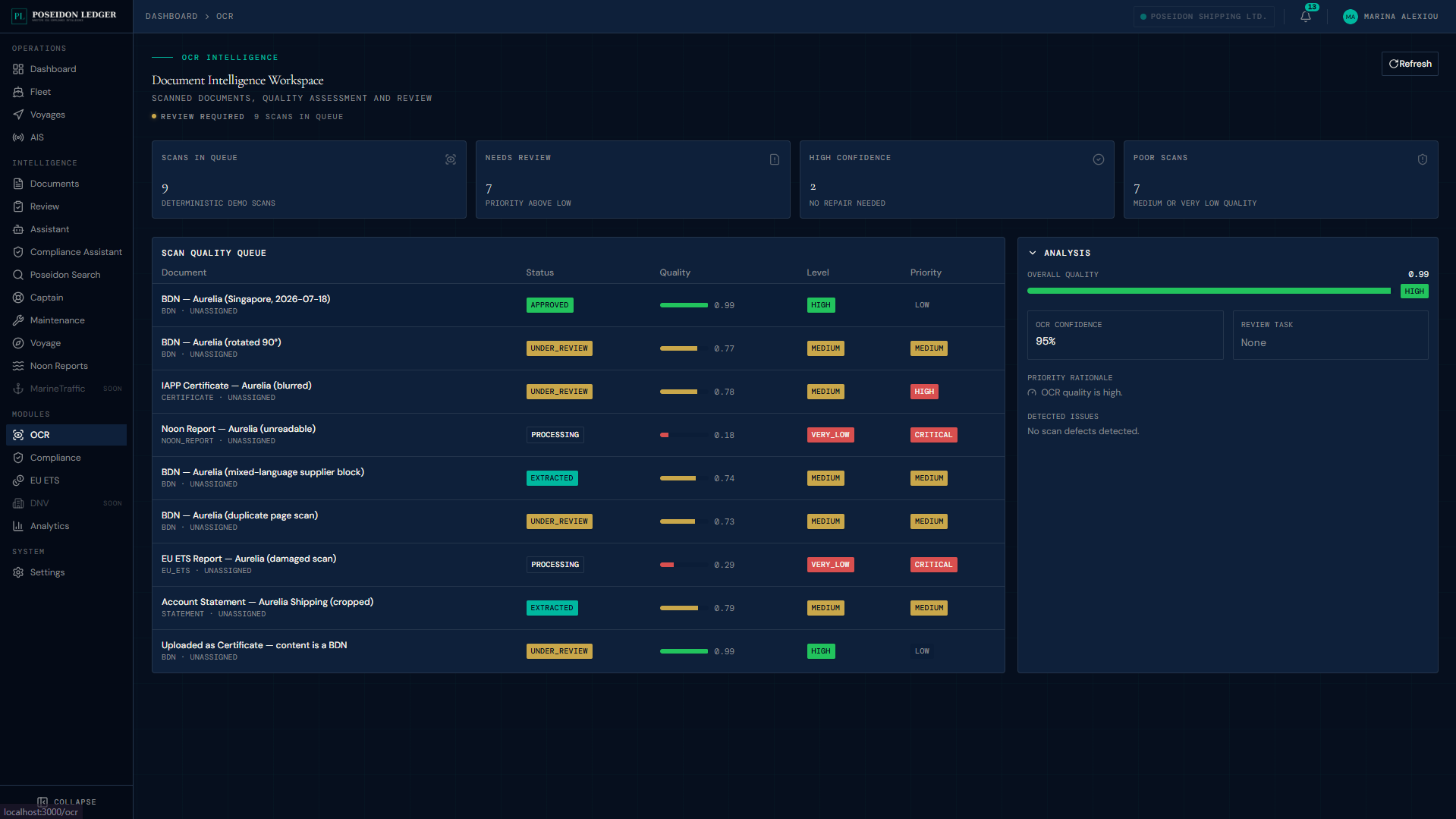
Poseidon Ledger - voyages view

What the platform does — in production.

Shipped capabilities, described without exaggeration. A feature is either live or on the roadmap; nothing here is staged.

CF · Live
Raw-Ledger Ingestion
NOON / end-of-day reports, BDN and ROB records are received in their original formats, preserved untouched, and normalised into one structured ledger. The original file stays attached to every row.
CF · Live
Voyage & Leg Boundaries
Port calls, voyage records and available routing evidence are resolved into regulatory legs with the applicable voyage phases (100% / 50% / 50%) per leg.
CF · Live
Continuous Posting
Consumption is published to an open leg the moment data arrives — attribution follows the operating profile, not a forecast.
CF · Live
Deterministic Calculation
Leg-level CO₂ and FuelEU intensity resolved with fixed, stated rules. The same inputs always produce the same output.
CF · Live
Evidence & Traceability
Every figure references the source records it came from and the rule applied — openable in one click during an audit.
CF · Live
User & Fleet Management
Fleet directory, vessel registry and role-scoped workspaces for operators, owners and their teams.
CF · Live
EU ETS Accounting
EU ETS obligations by voyage phase with per-leg attribution — the arithmetic the 30 September surrender depends on.
CF · Live
Audit Log
Timestamped, append-only audit records for ledger and calculation events.
CF · Live
Report Preparation
Structured output prepared for the next step in the chain — MRV reporting and FuelEU documentation workflows.

Planned — clearly labelled, never staged as live.

The integration surface grows as the product does. Anything listed here is a design commitment, not a promise of today's availability.

PLANNED
AIS-Fed Port-Call Onboarding
Automatic port-call and position ingestion to tighten voyage boundaries the moment a ship connects.
PLANNED
BDN & ROB OCR
Optical extraction of bunker delivery notes and sounding sheets into the ledger with source images attached.
PLANNED
EU MRV Submission Support
Structure-checked working files prepared towards the EU MRV workflow, with your verifier in the loop.
PLANNED
EUA Price Feed
Automatic, current EUA pricing for the exposure model — beyond the delayed reference read and manual reprice available today.
PLANNED
FuelEU Balancing & Pooling
Fleet-wide pooling and balance-of-accounting support once FuelEU certificate mechanics matter to the fleet.
PLANNED
Verifier Packages
A consolidated working file per vessel for your verifier — evidence, ledger and calculation in one export.
PLANNED
Report Template Library
Support for more NOON / EOS report layouts, vessel families and regional variations beyond the current intake.
PLANNED
DCS / EEXI / CII Reading
One-time and annual reading views for the broader IMO reporting stack alongside the EU workflows.

Estimate your fleet position against current law.

Set one representative ship and watch the numbers resolve — scope, EUA obligation, FuelEU deficit and Med ECA position resolve against the published current law. The same calculations the platform would run, transparent and inspectable.

Vessel input
A single representative ship · adjust anything and the result re-runs immediately
Fleet & vessel
1
4,500
4005,00020,000
Fuel & consumption
2,000
Activity & rules
50%
Outcome — single representative ship
Recalculates instantly on every input · constants below
Fleet CO₂, one year —
Illustrative annual cost —
Binding driver
Binding regime
Regime driving the marginal cost · EUA cost vs FuelEU deficit penalty
--
Scope & reporting
EU ETS obligation
Ships ≥ 5,000 GT calling at EU ports
--
EU MRV reporting
Verification applies to reporting ships
--
Exposure & cost
CO₂ estimate (fleet, yr)
Fuel × emission factor × fleet size
--
EUA obligation
Covered CO₂ × EU coverage × phase-in
--
Illustrative EUA cost (model)
MODEL ONLY · at EUR 83.34 Dec-26 close · reprice from the market read
--
FuelEU & Med ECA
FuelEU GHG intensity vs target
Single-ship case · obligation shown ≥ 5,000 GT
--
FuelEU surplus penalty (model)
Statutory €2,400 / t VLSFO-eq · deficit only
--
SOx ECA position
Depends on fuel sulphur vs 0.10% in ECA
--
Data readiness stance
Based on scope only — see the attribution ladder
--
Dec-26 contract · ICE / EEX
€83.34
Last close · 1 Sep 2026 · delayed market data
52wk 63.07 93.80
Model priced at €83.34 / EUA · click a session to reprice
30 sessions · point to inspect · click to reprice the model
01
Scope
GT threshold — 5,000 GT for EU ETS & FuelEU · 400 GT for MRV cargo/offshore
02
Factors
CO₂ = fuel × factor · MGO/LSMGO 3.206 · HFO 3.114 · VLSFO 3.151 t/t
03
Coverage
EU-ETS-relevant activity % × phase-in 40 / 70 / 100% by year
04
FuelEU
Intensity gCO₂e/MJ vs baseline 91.16 • −2% from 2025 • €2,400/t VLSFO-eq deficit

Model outputs are derived estimates for planning only, computed from the reference constants above. They are not a compliance opinion, a quote, or a guarantee. The 17 July 2026 below-5,000 GT proposal is not reflected. The calculation follows the EU ETS maritime 100/50/50 phase rule and FuelEU Art. 24 deficit mechanics for a single-ship case.

Scoped to the fleet — not a price ladder.

Commercial deployment is scoped to fleet size, data requirements and integration requirements. Every deployment runs the same ledger and the same deterministic calculation engine; the differences are fleet scale and service depth, not the quality of the mathematics.

Pilot
First Fleet
A first vessel or small fleet
✓ Validate the ledger on real reporting files
✓ Full evidence and traceability
✓ Entry through the 48-hour assessment
Enterprise
Management & Large Fleets
Large fleets and management companies
✓ Integration requirements review
✓ Data requirements scoping
✓ Dedicated support structure

Deployment is scoped in a structured review before any commitment — fleet size, data requirements and integration requirements are assessed first. Nothing on this page is a quote for a specific fleet.

Who this system is for.

01
Yacht Management Companies
Consumption and voyage records that hold together under inspection — built for the Mediterranean operating profile.
02
Fleet & Operations Managers
A single ledger across vessels — one source of truth for consumption and leg performance, readable at a glance.
03
Technical Superintendents
Bunker and machinery data kept in the raw values recorded on board — resolved deterministically, never re-guessed downstream.
04
ISM / DPA / Compliance Teams
Rules encoded as data, not institutional memory — so the answer to “where does this figure come from?” is one click away.
05
Maritime Advisors & Lawyers
Attributable per-leg records that survive scrutiny — a defensible, inspection-grade basis for advice.
06
Verifier-Facing Workflows
Structured, referenced ready-files that reduce the back-and-forth before sign-off.

We read your data. You get a position.

Send a sample of current reporting files — NOON reports, BDN / ROB, port calls. Poseidon Ledger reads them into a test ledger and returns a fleet assessment: scope position, data gaps and the shape of your next reporting cycle.

  • ✓

    Fixed 48-hour turnaround. Clearly scoped — no open-ended consulting.

  • ✓

    Sample-level handling. Assessment runs on the reporting files you provide, read into a test ledger.

  • ✓

    A concrete output. Scope position, gap list and a recommended structure for full onboarding.

Request the assessment